

Why Colorado Real Estate Savings Matter More Than Ever
Colorado real estate savings have become critical as home prices surge 40% over five years and mortgage rates hit 7.04% – the highest in eight months. Whether you’re buying your first home in Denver or selling a property in Boulder, understanding how to cut costs can save you tens of thousands of dollars.
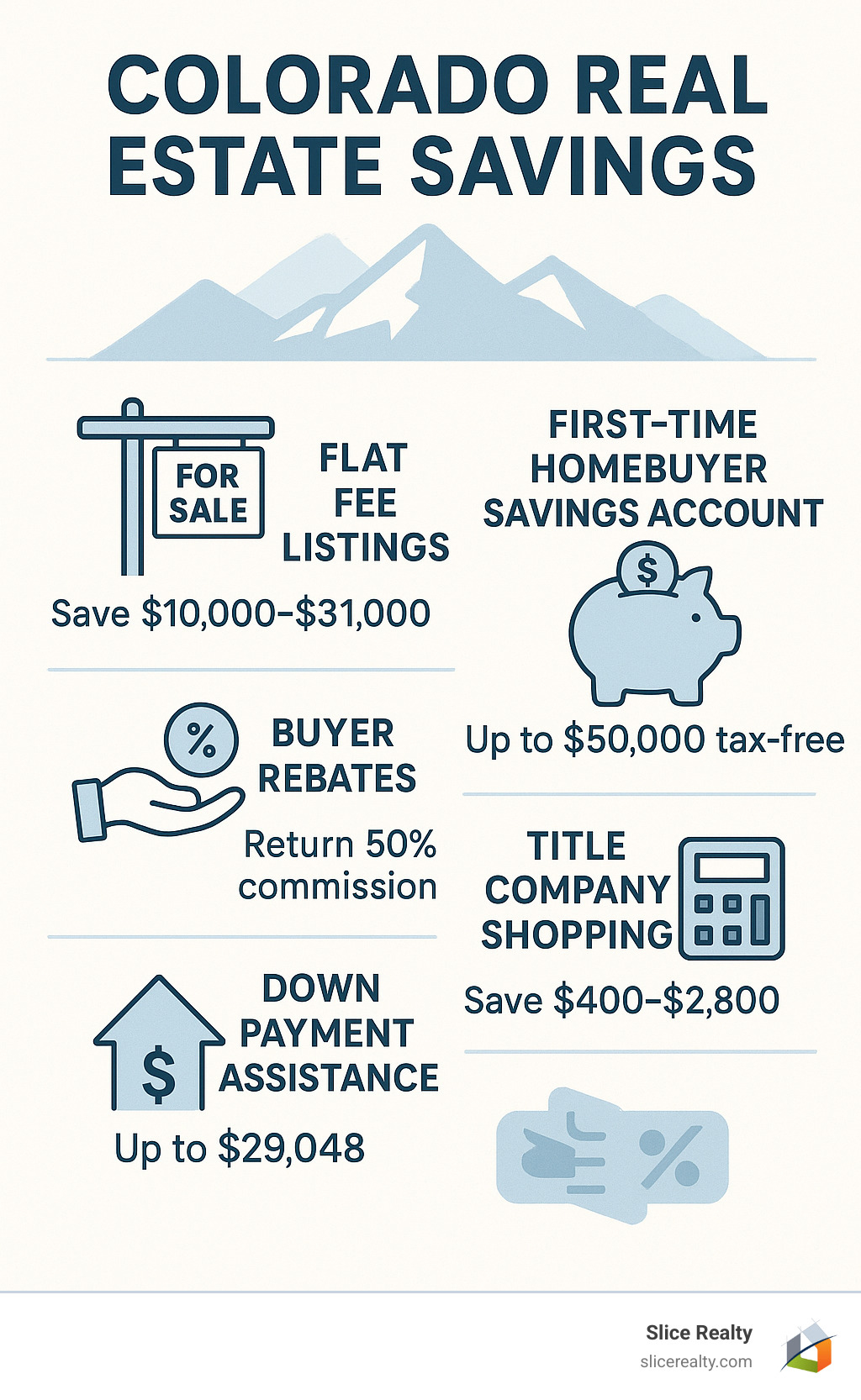
Quick Colorado Real Estate Savings Overview:
- Flat fee listings: Save $10,000-$31,000 vs traditional 5-6% commissions
- First-Time Homebuyer Savings Account: Up to $50,000 tax-free for closing costs
- Buyer rebates: Get 50% of agent commission back at closing
- Title company shopping: Save $400-$2,800 per transaction
- Down payment assistance: Access up to $29,048 in grants
The numbers tell the story. On Colorado’s average $600,000 home, traditional real estate commissions cost $30,000-$36,000. Flat fee services? Just $199-$5,000. That’s real money you can keep in your pocket instead of handing over to outdated commission structures.
Smart Colorado buyers and sellers are waking up to these opportunities. As one Aurora seller found when she chose her own title company: “I saved $600 just by making one phone call.” Meanwhile, the state’s First-Time Homebuyer Savings Account lets any Coloradan set aside up to $50,000 toward closing costs with tax-free earnings forever.
I’m Tommy Lorden, Managing Broker and founder of Buyers’ Slice Realty, and I’ve been helping Colorado clients maximize their Colorado real estate savings since 2009 through innovative flat-fee and rebate models. My legal background ensures you get both the savings and the protection you deserve in every transaction.
Colorado Real Estate Savings Playbook
When it comes to Colorado real estate savings, the numbers don’t lie. Let’s break down exactly what you’re paying with traditional real estate commissions versus what you could save with a flat fee model.
On a typical $600,000 Denver home sale, traditional commissions hit hard. You’re looking at 5-6% total commission, which means $30,000 to $36,000 walking out your door. That breaks down to $15,000-$18,000 for the listing agent and another $15,000-$18,000 for the buyer’s agent.
Now here’s where the flat fee model changes everything. Instead of that hefty listing agent commission, you pay a simple flat fee of $199 to $5,000. You still pay the buyer’s agent their 2.5-3% (that’s $15,000-$18,000), but your total cost drops to just $15,199-$23,000. That’s $13,000 to $16,000 back in your pocket.
This isn’t pocket change we’re talking about. That’s kitchen renovation money, or a solid chunk toward your next home’s down payment. It’s why Colorado homeowners are making the switch to flat fee services in record numbers.
For buyers, the savings story gets even better with rebate programs. Instead of your agent keeping the full 2.8% commission (pretty typical here in Colorado), you split it 50/50. On that same $600,000 home, you’d walk away with approximately $8,400 at closing. That’s enough to cover most of your closing costs and prepaids right there.
| Service Type | Listing Fee | Buyer Agent | Total Cost | Your Savings |
|---|---|---|---|---|
| Traditional (6%) | $18,000 | $18,000 | $36,000 | $0 |
| Flat Fee Model | $199-$5,000 | $18,000 | $18,199-$23,000 | $13,000-$17,801 |
More info about Flat Fee Real Estate
Top 5 Colorado real estate savings moves for sellers
Getting maximum MLS exposure without the maximum fees is your first smart move. Colorado requires a licensed broker to list on the MLS, but that doesn’t mean you need to pay 6% commission for the privilege. Flat fee listings get you full MLS exposure, professional photos, and automatic syndication to all the major sites like Zillow and Realtor.com.
DIY staging can deliver 95% of the impact at a fraction of the cost. Professional staging runs $2,000 to $5,000, but smart DIY staging focuses on what actually matters: decluttering, deep cleaning, and fresh neutral paint. Take those savings and invest in professional photography instead.
Smart pricing strategy beats wishful thinking every time. Homes priced 5% above market value sit 65% longer on average. Get a solid Comparative Market Analysis, price strategically from day one, then monitor market feedback weekly.
Negotiation goes way beyond price, and every point affects your bottom line. Think about inspection periods, closing dates, and repair credits as opportunities to save money. We’ve seen sellers save thousands by offering closing cost credits instead of straight price reductions.
Timing your market entry can make a real difference in your final numbers. Spring selling season brings 15-20% more buyers, but it also brings more competition. Consider listing in late February or early fall when inventory is lower but motivated buyers are still actively looking.
Colorado real estate savings hacks for buyers
Buyer rebate credits aren’t some marketing gimmick – they’re a modern approach that makes sense. Colorado allows buyer rebates, and splitting the commission 50/50 recognizes that you’re doing much of the home searching yourself online anyway. You handle the research and house hunting; we handle the negotiations, contracts, and closing details.
Inspection concession strategies require thinking beyond simple repair requests. Instead of asking for cash to fix everything, negotiate strategically. Request credits for items you can handle yourself at lower cost, like minor plumbing or electrical work.
Rate buydown opportunities make real sense with current rates at 7.04%. Ask sellers to contribute 1-2% of the purchase price toward buying down your rate for the first one to three years. This reduces your monthly payments when you need it most while you’re building equity.
Closing cost split negotiations can make your offer stand out without increasing the purchase price. In Colorado’s competitive market, offering to split closing costs 50/50 with sellers works especially well on homes that have been sitting on the market for 30+ days.
Tax-Advantaged Accounts & Assistance Programs
Colorado offers some of the nation’s most generous homebuyer assistance programs, yet most residents have no clue they exist. I’ve watched countless clients miss out on thousands in savings simply because they didn’t know about the Colorado real estate savings hiding in plain sight.
The state’s First-Time Homebuyer Savings Account alone can transform your home buying journey. Since 1974, the Colorado Housing and Finance Authority (CHFA) has pumped over $37.4 billion into our state’s economy, helping 155,501 Colorado families achieve homeownership.
The secret sauce? Stacking multiple programs together. I’ve personally helped clients combine FHSA tax savings, CHFA down payment assistance, and local grants to slash their out-of-pocket costs by $40,000 or more. When you know how to layer these programs correctly, even Colorado’s challenging market becomes manageable.

First-Time Homebuyer Savings Account essentials
Colorado’s FHSA is a game-changer for Colorado real estate savings. Think of it as a boosted savings account where the state of Colorado basically pays you to save for a home.
The contribution limits are surprisingly generous. Individual filers can stash away $14,000 per year, while married couples filing jointly can contribute up to $28,000 annually. Your lifetime cap sits at $50,000 in contributions, but your account can actually grow to $150,000 total through investment gains.
What makes this account truly special is flexibility. You’re not stuck with some boring government-mandated savings account. Almost any financial product can become an FHSA – savings accounts, money market accounts, CDs, mutual funds, brokerage accounts with stocks and bonds, even individual stocks or insurance products.
The tax benefits are impressive. All earnings – whether that’s interest, dividends, or capital gains – are permanently exempt from Colorado state taxes. As long as you use the money for eligible closing costs, the state never touches those gains.
Speaking of eligible expenses, Colorado keeps it simple. Anything that shows up on your settlement statement qualifies. Down payment, closing costs, appraisal fees, inspection costs, lender fees, title insurance, recording fees – it all counts.
But there are penalties if you mess up. Use the money for non-qualified expenses, and Colorado will recapture all those tax benefits you claimed over the years. Plus, you’ll face a 5% penalty if you withdraw within 10 years of your first deposit, or 10% after 10 years.
Here’s a bonus most people miss: you can gift FHSA funds to any first-time homebuyer. Children, grandchildren, nieces, nephews, even friends. Smart Colorado families are using this as an estate planning tool, helping multiple generations build wealth through homeownership.
More info about Colorado FHSA
Grants and down-payment help you can stack
The real magic happens when you start layering programs together. Most buyers think they have to choose one assistance program, but Colorado actually encourages stacking – and the savings can be massive.
CHFA Down Payment Assistance provides up to $25,000 for qualified buyers, often at below-market interest rates. But here’s what most people don’t realize – this can be combined with other programs without penalty.
The Colorado Home Grant Program offers up to $29,048 in grant money that never needs to be repaid. Both first-time and repeat buyers can qualify, making it one of the most generous programs in the entire nation.
Colorado cities have gotten into the game too. Denver’s DURA program offers up to $80,000 in assistance. Boulder provides down payment help up to $50,000. Colorado Springs runs first-time buyer programs with reduced interest rates. Fort Collins operates affordable housing programs with income-based assistance.
The stacking strategy I use with clients typically looks like this: Start with an FHSA for tax-free closing costs. Add a CHFA first mortgage with their down payment assistance. Layer in a municipal grant for additional down payment help. Finally, check if your employer offers homebuyer benefits.
When done correctly, I’ve watched families reduce their out-of-pocket costs from $60,000 down to under $20,000. That’s the difference between renting forever and owning your piece of Colorado.
Scientific research on Denver home prices
Slashing Hidden Transaction Costs
Real estate transactions come loaded with sneaky fees that can add thousands to your closing costs. The good news? Most of these hidden expenses can be reduced or eliminated entirely when you know where to look and how to negotiate.
I’ve seen Colorado buyers and sellers waste money on inflated title fees, overpriced inspections, and insurance policies they didn’t need to buy. The worst part? Many agents never mention you have choices. That changes when you understand your rights and take control of your transaction costs.
Your Right to Choose Settlement Providers = Instant Savings
Here’s something most Colorado agents won’t tell you: you have the federal right to choose your own settlement service providers. This includes title companies, and it’s protected under the Real Estate Settlement Procedures Act (RESPA).
Why does this matter for your Colorado real estate savings? Because title company fees can vary wildly – we’re talking $400 to $2,800 difference for the exact same service on comparable properties. That’s real money you can keep in your pocket just by making a few phone calls.
The fee variations happen for several reasons. Some title companies offer volume discounts for repeat clients or promotional rates to win new business. Others charge premium prices because they can get away with it when agents don’t give clients options. Geographic location also plays a role – title companies in different areas of Colorado may have vastly different pricing structures.
Your RESPA rights are pretty comprehensive. You can choose your own title company, shop for homeowner’s insurance, select your own appraiser when the lender allows it, and even pick where you want to close. These aren’t suggestions – they’re federal rights that protect you from being steered toward expensive service providers.
Taking action is straightforward. If your agent tries to restrict your choice of settlement providers, you can file complaints with the Colorado Division of Real Estate or the Consumer Financial Protection Bureau. We always provide our clients with multiple title company options and encourage shopping for the best combination of service and price.
Scientific research on title-fee-savings
Insurance, Inspections, and Other Sneaky Fees
Colorado’s insurance landscape got more complicated recently with HB23-1288 and related legislation. The state’s new insurance plan of last resort might actually increase premiums for all policyholders while reducing private market options. This makes smart insurance shopping even more critical.
Wildfire risk is the elephant in the room for Colorado homeowners. Properties in high-risk areas face significantly higher premiums, but you can fight back by maintaining defensible space around your property. Insurance companies offer lower rates when you demonstrate fire mitigation efforts. Bundling home and auto insurance typically saves 10-15%, and increasing deductibles can lower premiums if you have the financial cushion to handle higher out-of-pocket costs.
The key is shopping annually. Colorado’s insurance market changes rapidly, and companies that were expensive last year might be competitive this year. Don’t just renew automatically – it’s costing you money.
Inspection bundles offer another opportunity for savings. Instead of paying for individual inspections, negotiate package deals. A general inspection plus pest inspection often costs 20% less than booking them separately. Radon and water quality testing can be bundled for additional savings, and HVAC plus electrical inspections from specialists reduce travel costs that get passed on to you.
When inspections reveal issues, here’s a pro tip: negotiate repair credits rather than actual repairs. This gives you control over contractors and costs while avoiding closing delays. We’ve seen buyers save 30-50% by handling repairs themselves with negotiated credits instead of letting sellers choose the cheapest contractors to do quick fixes.
More info about Discount Real Estate Broker

Market & Investment Strategies for Long-Term Savings
Colorado’s real estate market presents unique opportunities for long-term Colorado real estate savings through strategic investment and financing approaches. With mortgage rates at 7.04% and home prices up 40% over five years, timing and strategy matter more than ever.
Current Market Reality:
– Average Denver home price: $600,000 (up from $400,000 five years ago)
– Average time on market: 27-45 days depending on location
– Mortgage rates: 7.04% for 30-year fixed
– Inventory levels: Still below historical norms in most Front Range markets
Investment Opportunities:
Colorado’s diverse economy spanning technology, healthcare, and tourism creates sustained housing demand. Vacation rentals in mountain areas can yield substantial returns, while Front Range properties benefit from job growth and population increases.
Financing Smartly to Maximize Colorado Real Estate Savings
Rate Lock Strategies
With volatile rate environments, lock strategies become crucial:
– 30-day locks for quick closings
– 60-day locks for standard transactions
– 90-day locks for new construction or complex transactions
– Float-down options when available
HELOC Bridge Financing
For move-up buyers, Home Equity Lines of Credit (HELOCs) can bridge the gap between selling and buying:
– Access equity without selling first
– Stronger purchase offers (no sale contingency)
– Flexibility to time both transactions optimally
Refinance Timing
Even at current rates, refinancing makes sense for:
– Removing PMI when you reach 20% equity
– Switching from ARM to fixed-rate loans
– Cash-out refinancing for investment properties
– Consolidating high-interest debt
1031 Exchange Benefits
For investment properties, 1031 exchanges allow tax-deferred growth:
– Defer capital gains taxes indefinitely
– Upgrade to larger or better-located properties
– Build wealth through leverage and appreciation
Managing Properties for Efficiency and Profit
Tenant Screening Excellence
Proper screening prevents costly evictions and property damage:
– Credit scores above 650 preferred
– Income 3x monthly rent minimum
– Employment verification
– Previous landlord references
– Background checks for criminal history
Preventive Maintenance Programs
Proactive maintenance costs less than reactive repairs:
– Annual HVAC service saves 15-20% on energy costs
– Gutter cleaning prevents foundation issues
– Regular inspections catch small problems early
– Tenant education reduces damage and service calls
Tax Deduction Maximization
Colorado rental property owners can deduct:
– Mortgage interest and property taxes
– Repairs and maintenance costs
– Property management fees
– Depreciation (major tax benefit)
– Travel expenses for property management
– Professional services (legal, accounting)
Short-Term Rental Considerations
Colorado’s short-term rental market offers opportunities but requires compliance:
– Local licensing requirements vary by municipality
– HOA restrictions may apply
– Tax obligations include state and local lodging taxes
– Insurance requirements differ from traditional rentals
Frequently Asked Questions about Colorado Real Estate Savings
Let me answer the most common questions I hear from Colorado buyers and sellers about maximizing their savings. These are real concerns from real people who want to keep more money in their pockets.
How much can flat fee services save me in Colorado?
The numbers are eye-opening. Colorado real estate savings through flat fee services typically range from $10,000 to $31,000 compared to traditional commission structures. I’ve seen families use these savings for everything from kitchen renovations to college funds.
Here’s how the math works on real Colorado homes:
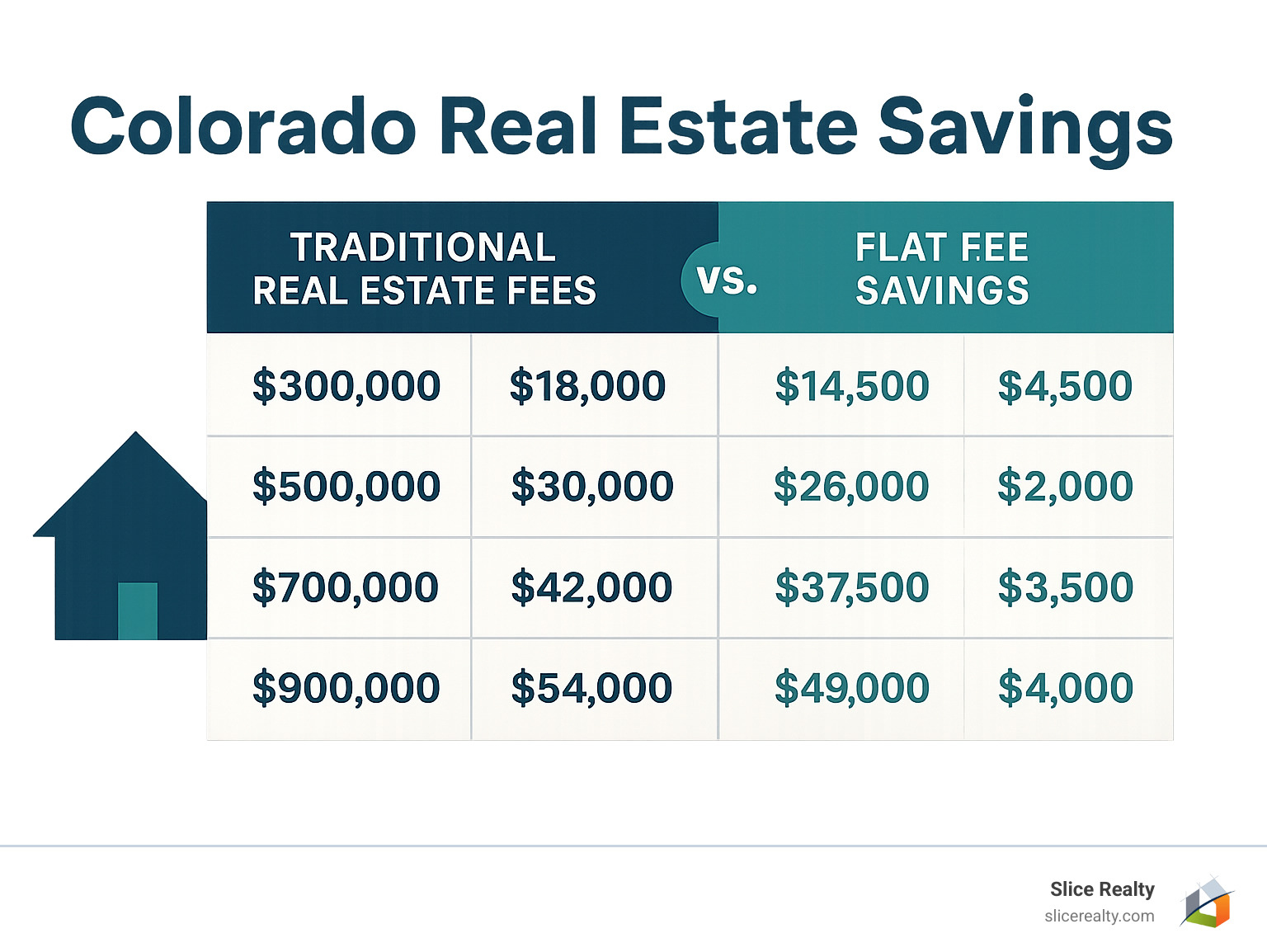
On a $400,000 home (common in Colorado Springs or suburban Denver), you’re looking at $24,000 in traditional 6% commissions versus $15,000-$17,000 with flat fee plus buyer agent compensation. That’s $7,000-$9,000 back in your pocket.
On a $600,000 home (Colorado’s current average), traditional commissions hit $36,000. Our flat fee approach brings that down to $20,000-$23,000 total. You save $13,000-$16,000 – enough for a nice vacation or significant home improvements.
On a $1,000,000 home (think Boulder or upscale Denver neighborhoods), the savings become truly dramatic. Traditional commissions would cost $60,000, while our approach totals around $33,500. That’s $26,500 in savings that stays with you instead of going to commission payments.
The beauty is you still get full MLS exposure, professional photography, and complete transaction support. You’re just not paying outdated percentage-based fees that made sense decades ago but don’t reflect today’s market realities.
Am I eligible to open a Colorado FHSA?
Colorado’s First-Time Homebuyer Savings Account has surprisingly generous eligibility rules. Most people qualify, even if they think they don’t.
The first-time buyer definition is broader than you might expect. You qualify if you’ve never purchased a home before – whether single-family, condo, co-op, townhouse, or mobile home. But here’s what many people don’t know: inherited property doesn’t disqualify you. Neither does being divorced if you never actually purchased during your marriage.
Contribution limits are generous too. Individual filers can contribute $14,000 annually, while joint filers can put in $28,000 per year. The lifetime contribution cap is $50,000, but your account can grow to $150,000 through investments and interest.
Setting up the account is straightforward. Any Colorado financial institution can help you designate an FHSA. You can use existing accounts, open new ones, or even have multiple FHSA accounts. Joint accounts work fine too.
The qualified beneficiary rules add flexibility. You must designate a beneficiary by April 15 following the tax year, but you can change beneficiaries as needed. Even better, you can gift FHSA funds to other qualified first-time buyers – children, grandchildren, or even friends.
More info about Colorado FHSA
Can I really choose my own title company?
Absolutely, and this surprises many Colorado buyers and sellers. Federal law (RESPA) guarantees your right to choose settlement service providers, yet agents often don’t mention this money-saving opportunity.
Your legal rights include selecting any licensed title company, choosing your own homeowner’s insurance, picking the settlement location, and shopping for the best combination of price and service. These aren’t suggestions – they’re federal rights.
The potential savings are significant. Recent analysis shows Colorado title company fees can vary by $400 to $2,800 on comparable transactions. One of our Aurora sellers saved $600 simply by choosing her own title company instead of using her agent’s default recommendation.
Taking action is simple. Request quotes from 2-3 title companies, compare total fees (not just title insurance premiums), ask about discounts for previous customers, and consider both service quality and location convenience.
If your rights are restricted, you have recourse. File complaints with the Colorado Division of Real Estate or the Consumer Financial Protection Bureau (CFPB). I always provide multiple title company options and encourage clients to shop for the best value because it’s your money and your choice.
The key is knowing these rights exist. Too many Colorado real estate transactions happen with buyers and sellers simply accepting their agent’s preferred providers without realizing they could save hundreds or thousands by shopping around.
Conclusion & Next Steps to Open up Your Colorado Real Estate Savings
The path to Colorado real estate savings is clearer than ever. With home prices climbing 40% and mortgage rates hitting multi-year highs, the old way of doing business simply costs too much. Every seller paying 6% commission is leaving thousands on the table. Every buyer accepting standard terms is missing opportunities to keep more money in their pocket.
Think about it this way: on Colorado’s average $600,000 home, traditional commissions alone cost $36,000. That’s a year of college tuition, a kitchen renovation, or a solid start on your next investment property. Why hand that over when flat-fee services deliver the same results for a fraction of the cost?
The equity you keep today becomes the foundation for tomorrow’s opportunities. Whether you’re a first-time buyer in Thornton or a seasoned investor in Aspen, every dollar saved compounds over time. That $15,000 you keep from commission savings could become $50,000 in your next property’s appreciation.
Our lawyer-led approach at Slice Realty isn’t just about cutting costs – it’s about maximizing your long-term wealth building. Since 2009, we’ve watched clients use their transaction savings to upgrade homes faster, invest in rental properties sooner, and build generational wealth more effectively.
For sellers, the math is straightforward: calculate your flat-fee savings, invest those dollars in professional photography and strategic pricing, then shop title companies for additional transaction savings. Time your listing right, and you’ll keep more equity while still achieving top-dollar results.
For buyers, start your FHSA today – even if you’re not buying for two years. Research Colorado’s generous grant programs while mortgage rates are high, knowing that every tax-free dollar you save now reduces your future closing costs.
For investors, Colorado’s diverse economy creates sustained opportunities. Leverage financing smartly, implement professional management systems, and take advantage of tax benefits that can dramatically improve your returns.
The mountains should be high – your real estate costs shouldn’t be. Whether you’re planning your next move in six months or two years, understanding these Colorado real estate savings strategies positions you for success.
Ready to keep more of your hard-earned equity? Let’s discuss how our transparent, flat-fee approach can save you thousands on your next Colorado real estate transaction.
