

Why Colorado Sellers Are Switching to Flat Fee Models
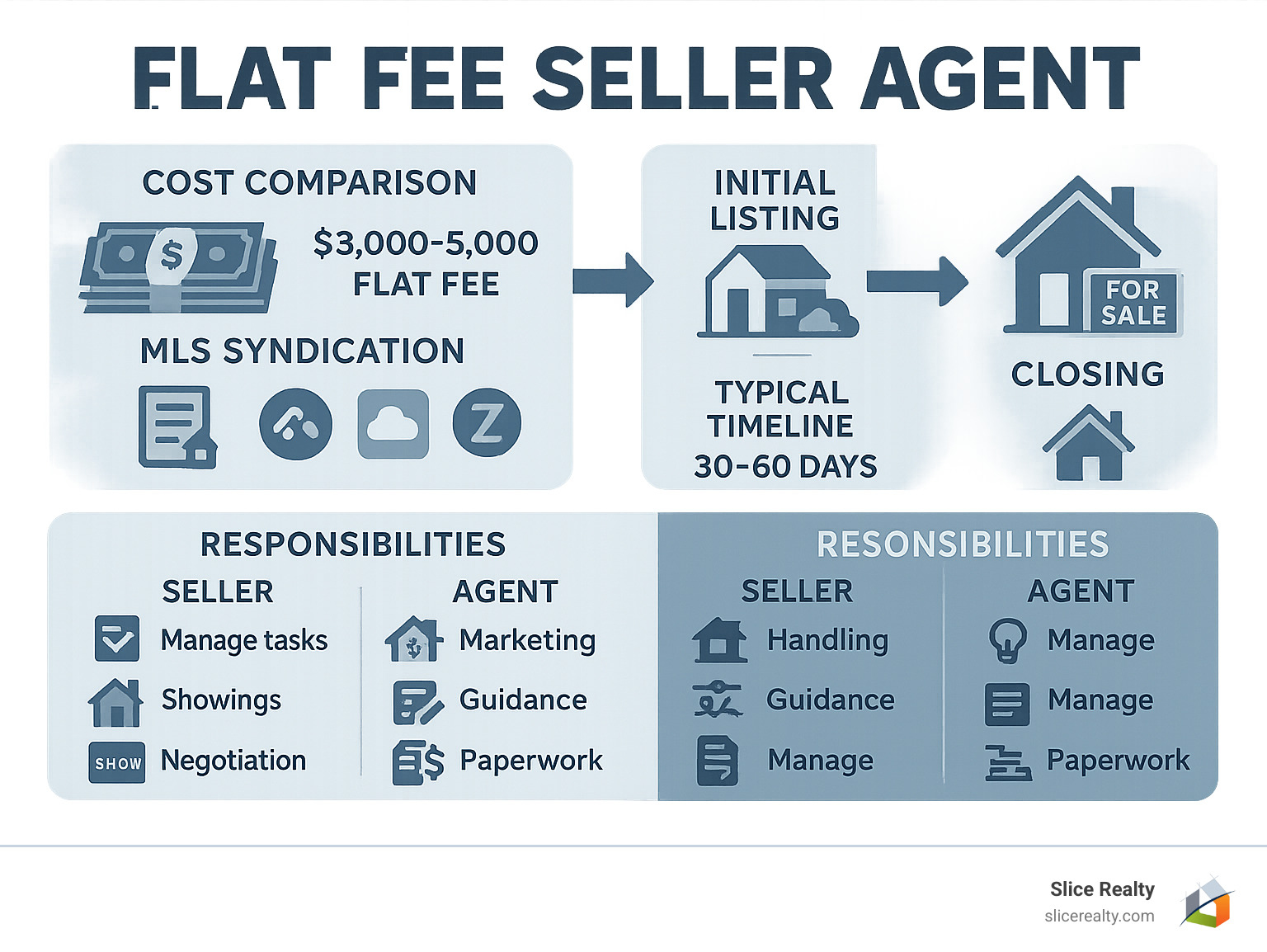
A flat fee seller agent charges a fixed price to sell your home instead of taking a percentage of your sale price. With traditional agents charging 5-6% commission (over $25,000 on a $425,000 home), flat fee agents typically charge $3,000-$5,000 regardless of your home’s value.
Quick Answer: What You Need to Know
- Fixed Cost: Pay $3,000-$5,000 flat fee vs. 5-6% commission
- Full MLS Access: Your home appears on all major real estate websites
- Service Levels: Range from MLS-only to full-service packages
- Buyer Agent Fees: You still pay buyer’s agent (typically 2.4% in 2025)
- Best For: Experienced sellers, hot markets, high-value homes
The numbers speak for themselves. On a $500,000 home sale, you’d pay $25,000-$30,000 in traditional commissions versus a $5,000 flat fee – saving you $20,000-$25,000. That’s real money that stays in your pocket.
But here’s what most sellers don’t realize: not all flat fee services are created equal. Some charge hidden fees for photos, signs, or contract changes. Others provide minimal support when negotiations get tough.
The 2024 NAR settlement changed the game too. Sellers are no longer required to pay buyer’s agent commissions upfront, making flat fee models even more attractive for savvy homeowners.
I’m Tommy Lorden, Managing Broker at Slice Realty, and I’ve been helping Colorado sellers steer flat fee seller agent options since 2009 with my legal background ensuring every transaction is handled properly. My experience has shown me exactly what works – and what doesn’t – when choosing between traditional and flat fee models.
Flat fee seller agent further reading:
What Is a Flat Fee Seller Agent?
A flat fee seller agent is a licensed real estate professional who charges a predetermined, fixed amount to list and sell your home, rather than taking a percentage of your final sale price. This model has gained significant traction following the 2024 NAR settlement, which eliminated the requirement for sellers to automatically pay buyer’s agent commissions.
The typical flat fee ranges from $3,000 to $5,000, regardless of whether you’re selling a $200,000 starter home or a $2 million luxury property. This pricing structure provides complete transparency – you know exactly what you’ll pay upfront, making it easier to calculate your net proceeds.
Here’s how the math works: On the national median home price of $425,061, a traditional 6% commission would cost you over $25,500. With a flat fee of $5,000, you save more than $20,000. The savings become even more dramatic on higher-priced homes.

Flat Fee Seller Agent vs. Traditional Commission Agent
The fundamental difference lies in the pricing model and service scope. Traditional agents work on a percentage basis – typically 2.5-3% for the listing agent – meaning their compensation increases with your home’s sale price. A flat fee seller agent receives the same payment whether your home sells for $300,000 or $800,000.
Pricing Model Comparison:
| Home Sale Price | Traditional 6% Commission | $5,000 Flat Fee | Your Savings |
|---|---|---|---|
| $300,000 | $18,000 | $5,000 | $13,000 |
| $500,000 | $30,000 | $5,000 | $25,000 |
| $750,000 | $45,000 | $5,000 | $40,000 |
| $1,000,000 | $60,000 | $5,000 | $55,000 |
This pricing difference affects negotiation leverage too. Traditional agents have an incentive to push for higher prices since their commission increases. Flat fee agents focus on getting your home sold efficiently since they’re paid the same amount regardless of the final price.
However, service scope can vary significantly. Some flat fee agents provide full-service support including staging advice, professional photography, and negotiation assistance. Others offer minimal service beyond MLS listing. We’ll cover these distinctions in detail below.
Types of Flat Fee Seller Services
Not all flat fee services are identical. Understanding the different models helps you choose the right fit for your situation and experience level.
Flat Fee MLS Services charge $100-$400 for basic MLS listing only. You handle everything else – photos, showings, negotiations, and paperwork. This bare-bones approach works for experienced sellers who want maximum control and minimal cost.
Full-Service Flat Fee Agents charge $3,000-$5,000 but provide comprehensive support including professional photography, marketing, showing coordination, offer negotiation, and closing assistance. This model offers the best of both worlds – significant savings with professional guidance.
Hybrid Discount Models combine flat fees with reduced percentage commissions. For example, some brokerages charge 1% plus a flat fee, or offer tiered pricing based on service level.
À-la-Carte Add-ons let you customize your service package. Start with basic MLS listing and add professional photos ($200-$500), yard signs ($50-$150), or lockbox services ($25-$75) as needed.
Geographic Coverage varies too. National platforms often charge upfront fees but outsource local work to unfamiliar agents. Regional brokerages like ours provide local expertise and direct agent relationships, which proves invaluable during complex negotiations.
How a Flat Fee Listing Works From Sign-Up to Sold
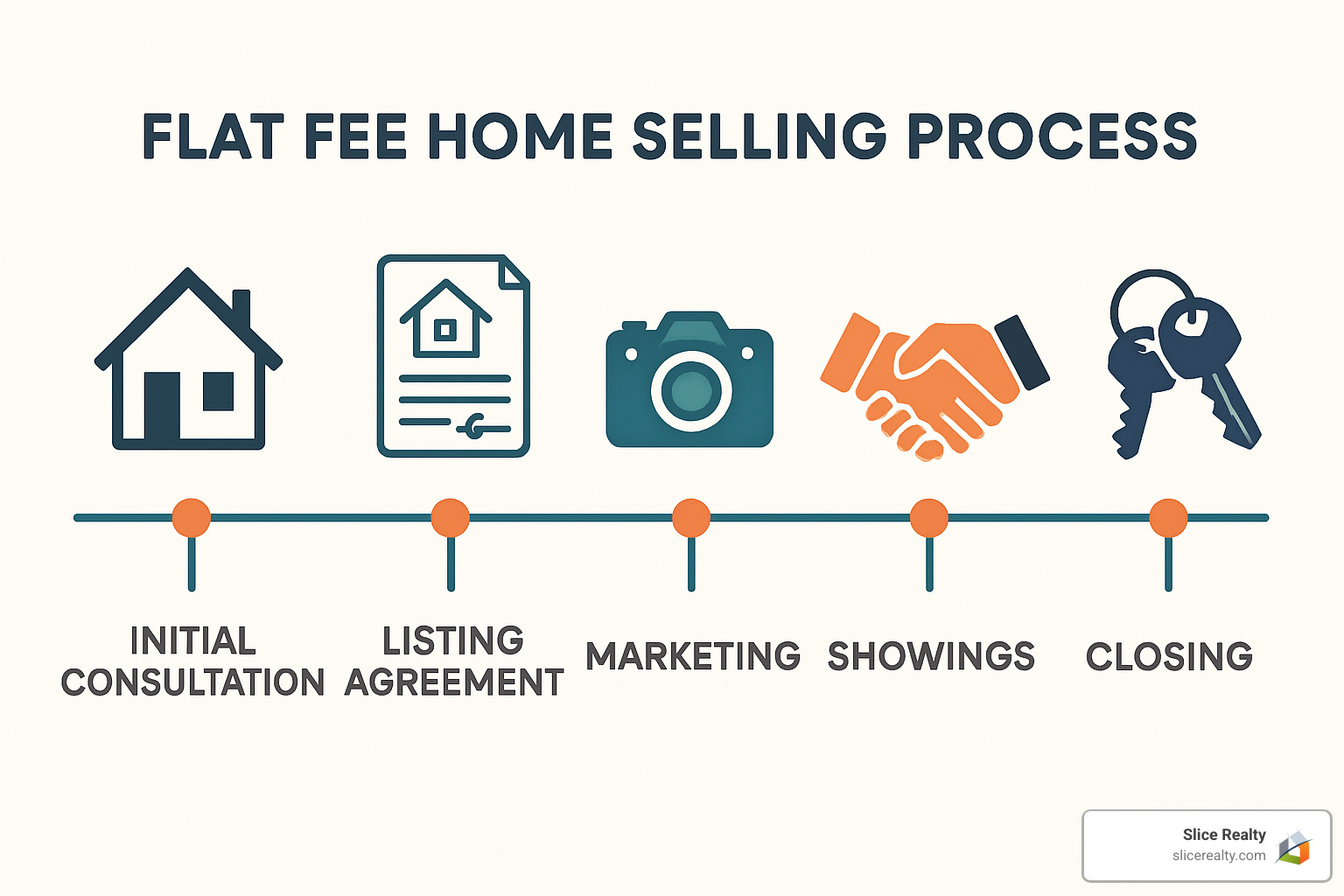
The flat fee seller agent process might seem mysterious, but it’s actually quite straightforward once you understand the timeline. Having guided hundreds of Colorado sellers through this journey, I can walk you through exactly what happens from the moment you sign up until you hand over the keys.
Getting Started: Your First Week
Everything begins with signing your listing agreement, which spells out exactly what you’re paying and what services you’re getting. No surprises, no hidden fees – just clear expectations from day one. You’ll spend this week gathering your property documents, completing disclosure forms, and working with your agent to price your home correctly.
Professional photography usually happens during this first week too, assuming it’s included in your package. This step is crucial because 78% of buyers start their home search online, and great photos can make or break that first impression.
Going Live: Week Two
This is when the magic happens. Your home gets uploaded to the MLS with all those professional photos and a compelling description. Within hours, your listing automatically appears on Zillow, Realtor.com, and dozens of other websites where buyers are actively searching.
Your yard sign goes up, the lockbox gets installed, and suddenly you’re officially on the market. It’s exciting and a little nerve-wracking all at once.
The Active Marketing Phase: Weeks 3-8
Now the real work begins. Showings start getting scheduled, and you’ll need to keep your home in showing condition. Your agent coordinates these appointments and collects feedback from visiting agents and buyers.
This phase requires the most effort from you as a seller. Unlike traditional agents who might handle every showing call, many flat fee services expect you to be more involved in the day-to-day coordination. The trade-off is worth it – you’re saving thousands while still getting professional support when you need it most.
Offers and Negotiations: Weeks 6-10
When offers start coming in, this is where your flat fee seller agent really earns their fee. Contract negotiation is complex, and having professional expertise becomes invaluable. You’ll review purchase offers together, prepare counteroffers, and negotiate everything from price to closing dates.
The inspection and appraisal process happens during this phase too. Issues always come up – they’re part of every real estate transaction. Your agent helps you steer these challenges and keep the deal moving forward.
Closing: Weeks 10-12
The final stretch involves coordinating with the title company, ensuring all contingencies are met, and preparing for the closing. You’ll do a final walkthrough with the buyers, attend the closing appointment, and finally – hand over those keys.
The entire process typically takes 30-60 days from listing to closing, similar to traditional listings. The main difference is that you’re more involved in the day-to-day details, which actually gives you more control over your sale.
One thing I always tell sellers: the process isn’t harder, it’s just different. You’ll handle more of the routine coordination yourself, but professional support is there when negotiations get complex or legal issues arise.
For a detailed breakdown of each step, check out our Flat Fee House Sale guide.
Handling Buyer’s Agent Commissions Under the New Rules
The 2024 NAR settlement changed everything about buyer’s agent commissions, and honestly, it’s been a game-changer for flat fee sellers. The old system automatically stuck you with both listing and buyer’s agent commissions. Now you have choices.
Here’s what’s actually happening in the market: Buyer’s agent commissions are averaging 2.4% in early 2025, down from the previous 2.5-3% standard. More importantly, buyers must now sign agreements with their agents before viewing homes, which means they’re much more aware of commission costs.
Your Three Main Options
You can offer a courtesy commission of 2-3% to attract the maximum number of buyers. Most sellers still choose this route because it keeps all buyers in the game, regardless of their agent arrangements.
Alternatively, you can negotiate per offer – deciding case-by-case whether to pay buyer’s agent fees based on the strength of each offer. This gives you leverage, especially in competitive situations.
The third option is going zero commission and targeting buyers who work with discount or flat fee buyer’s agents. This strategy works best in hot markets where inventory is tight.
Staying Compliant
The new rules require clear communication upfront. Your listing must state your commission policy clearly – no surprises for anyone. All agreements need to be in writing, and you’ll want to understand your state’s specific disclosure requirements.
Working with an experienced agent who understands these new rules is crucial. The regulatory landscape is still evolving, and you don’t want to accidentally violate any requirements.
The beautiful thing about this new system is that flat fee sellers actually benefit. Instead of automatically paying buyer’s agent commissions through your listing agent’s fee structure, you can choose whether and how much to pay based on your specific situation.
Costs: Flat Fee Packages vs. Percentage Fees in 2025
Let’s talk real numbers, because that’s what matters when you’re deciding between a flat fee seller agent and traditional commission structure. With the national median home price hitting $425,061 in February 2025, the savings are more significant than ever.
Traditional agents typically charge 5-6% total commission – that’s $21,253 to $25,504 on a median-priced home. Your listing agent takes 2.5-3% ($10,626-$12,752), and the buyer’s agent gets the same amount.
Flat fee agents charge $3,000-$5,000 regardless of your home’s price. Add the buyer’s agent commission of 2.4% (about $10,201 on that median home), and your total cost becomes $13,201-$15,201.
Your savings: $6,052-$12,303 on a median-priced home. That’s real money that stays in your pocket.
The savings become even more dramatic on higher-priced homes. Sell a $750,000 home and you’ll save $25,000-$40,000. On a million-dollar home, you’re looking at $40,000-$55,000 in savings. These aren’t small numbers – they’re life-changing amounts for most families.
But here’s the key question: Do flat fee listings sell for less money?
Research shows that homes listed on MLS sell for approximately 38% more than comparable FSBO properties. Since flat fee agents provide full MLS access and professional marketing, you get the same price advantage as traditional listings while saving thousands in commissions.
The math is compelling, but success depends on choosing the right flat fee service level for your experience and market conditions. A basic MLS-only listing might save you the most money upfront, but full-service flat fee agents often deliver better results for most sellers.
For comprehensive data on MLS performance and pricing trends, the NAR Research and Statistics page provides scientific backing for these numbers.
Pros, Cons, and Potential Pitfalls
Let’s be honest about what you’re getting into. A flat fee seller agent isn’t magic – it’s a trade-off between saving money and potentially doing more work yourself. The key is understanding exactly what you’re signing up for.
The upside is pretty compelling. You’ll know your exact costs from day one, which makes planning your next move so much easier. Instead of wondering whether your agent will take $25,000 or $30,000 in commissions, you budget $5,000 and move on. That predictability is worth something, especially when you’re coordinating buying and selling simultaneously.
The savings speak for themselves. On a $500,000 home, you’re keeping an extra $20,000+ in your pocket. That’s a new car, a down payment boost, or a very nice vacation. Even on more modest homes, you’re typically saving $10,000-$15,000 compared to traditional commissions.
Here’s something most people don’t consider: flat fee agents aren’t trying to talk you into higher listing prices to boost their commission. They get paid the same whether you sell for $400,000 or $450,000, so they’re more likely to give you straight talk about realistic pricing.
You’ll also maintain more control over the process. Want to schedule showings differently? Prefer certain negotiation strategies? With a flat fee arrangement, you’re more of a partner than a passenger.
Now for the reality check. Not all flat fee agents provide the same level of service. Some will list your home and basically disappear until an offer comes in. Others provide comprehensive support throughout the entire process. The difference is huge when you’re dealing with inspection issues or appraisal problems.
Watch out for hidden fees too. That $3,000 flat fee might not include professional photography, yard signs, or contract modifications. Suddenly your “flat fee” has grown to $5,000 or more.
The biggest risk? Taking on more responsibility than you’re prepared for. If you’re handling showings, disclosures, and negotiations yourself, you need to understand the legal implications. Colorado has specific disclosure requirements, and mistakes can be costly.

When a Flat Fee Seller Agent Makes Sense
A flat fee seller agent works beautifully in certain situations. If you’re selling in a hot market where homes get multiple offers within days, you don’t need extensive marketing campaigns or hand-holding. The market is doing the heavy lifting.
High-value homes are perfect candidates. When you’re selling a $750,000 property, saving $40,000 in commissions makes any extra effort worthwhile. The math just works better as your home value increases.
Experience matters tremendously. If you’ve sold homes before and understand contracts, inspections, and closing procedures, you can handle the additional responsibilities that come with flat fee services. First-time sellers often underestimate how complex real estate transactions can become.
Investment properties are ideal for flat fee arrangements. Investors typically understand the process, want predictable costs, and don’t need emotional hand-holding. They’re focused on numbers, not nurturing relationships.
Turnkey properties – those beautiful, well-maintained homes that show perfectly – sell themselves with minimal marketing. If your home doesn’t need staging advice or extensive preparation, basic flat fee services often suffice.
Technology comfort helps too. Modern flat fee arrangements often involve online scheduling systems, digital document signing, and app-based communication. If you’re comfortable with technology, the process flows smoothly.
Risks You Should Plan For
Pricing mistakes can be expensive. Some flat fee agents don’t invest much time in market analysis since they’re paid the same regardless. Do your own research on comparable sales and get multiple pricing opinions. An overpriced home sits on the market; an underpriced home costs you money.
Buyer’s agents sometimes avoid flat fee listings, thinking they’ll get less support or cooperation. Counter this by offering competitive buyer’s agent commissions and ensuring your listing clearly communicates your professionalism.
Legal disclosure errors are your responsibility if you’re handling them yourself. Colorado requires specific disclosures about property condition, neighborhood issues, and known defects. Mistakes can lead to lawsuits or deal cancellations. Work with agents who provide legal guidance or consult an attorney directly.
Appraisal problems catch many sellers off guard. If the appraised value comes in low, you need negotiation skills and market knowledge to resolve the situation. Limited agent support can leave you scrambling for solutions.
Time-on-market can stretch longer if your marketing package is basic. Budget for additional advertising if your home doesn’t generate adequate showing activity within the first few weeks.
The biggest risk is simply being unprepared for how much coordination real estate transactions require. Between inspections, appraisals, repairs, and closing logistics, there’s a lot to manage. Make sure you have the time and energy to handle these responsibilities effectively.
How to Choose the Best Flat Fee Brokerage for Your Home
Finding the right flat fee seller agent can make the difference between a smooth sale and a stressful experience. After helping hundreds of Colorado sellers steer this choice, I’ve learned that the cheapest option isn’t always the best value.
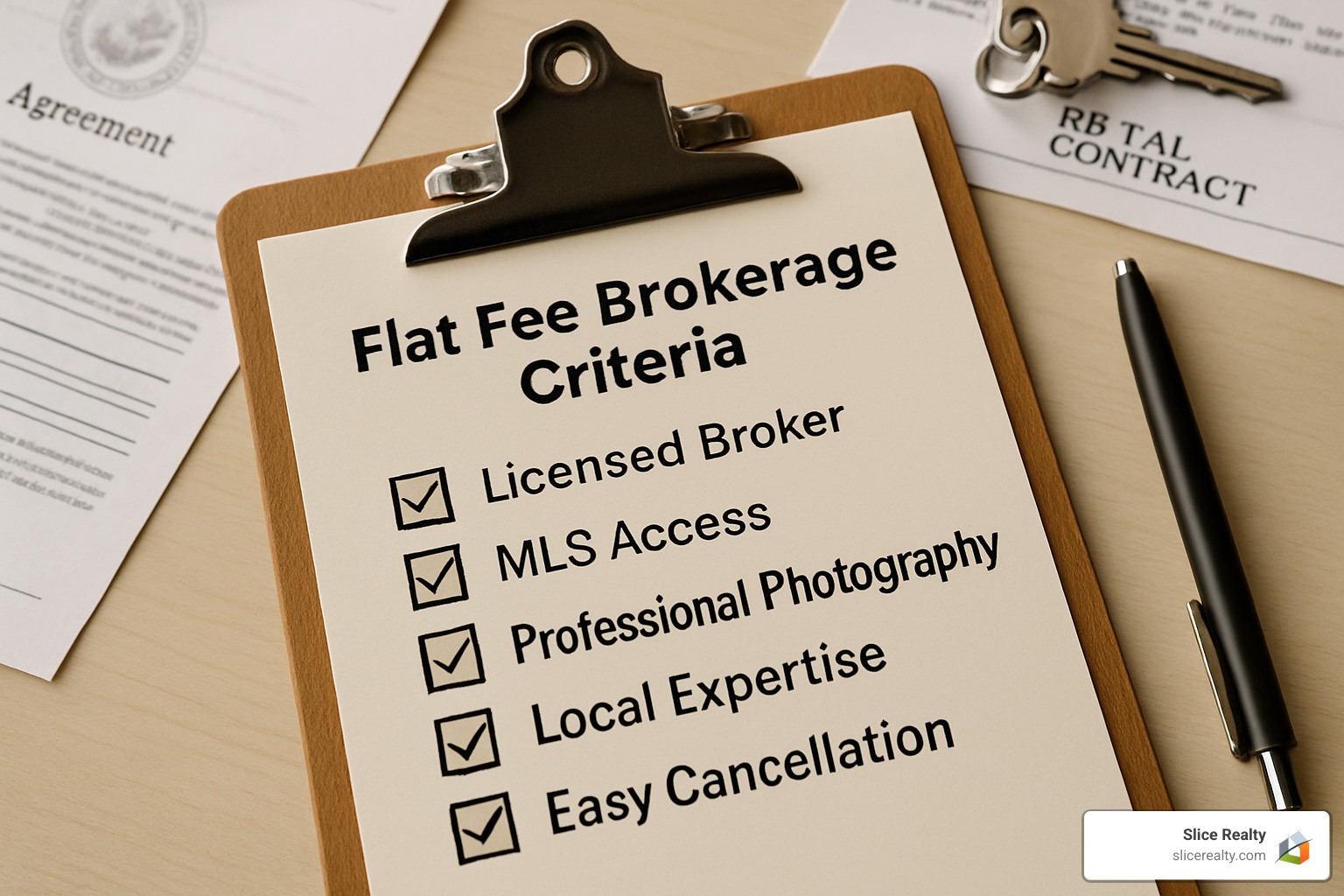
Start with credentials and licensing. Your agent should be a licensed real estate broker, not just an agent working under someone else’s license. They need current errors and omissions insurance coverage to protect you if something goes wrong. Check their Better Business Bureau rating and ask for recent client references. A legitimate brokerage will gladly provide these.
MLS access is absolutely critical. Make sure your agent has direct MLS access, not third-party syndication that can delay or limit your listing’s exposure. Your home should automatically appear on all major real estate websites like Zillow and Realtor.com. Professional photography and virtual tour capabilities are essential in today’s market – most buyers start their search online.
The service inclusions matter more than the headline price. Your flat fee should include a comparative market analysis to help price your home correctly. Professional listing photography and compelling descriptions are non-negotiable. Yard signs and lockboxes seem basic, but some brokerages charge extra for these essentials.
Geographic expertise gives you a huge advantage. Regional brokerages understand local market conditions, pricing trends, and what buyers in your area actually want. We’ve been serving the Colorado Front Range including Boulder, Denver, Colorado Springs, Fort Collins, Erie, and Aurora since 2009. That local knowledge proves invaluable when pricing your home and negotiating with buyers.
Cancellation flexibility protects you if things don’t work out. Look for brokerages that offer easy cancellation if you’re unsatisfied with service or market response. Avoid long-term contracts with excessive cancellation fees – you shouldn’t be trapped with an agent who isn’t delivering results.
Technology matters too. Electronic signature and document management systems make the process smoother for everyone involved. Your agent should handle showing coordination and provide feedback collection so you know how buyers are responding to your home.
For more details about our approach to transparent pricing and comprehensive service, check out our Flat Fee Realtor Denver and Transparent Real Estate Fees pages.
Questions to Ask Before You Sign
Don’t sign any listing agreement without getting clear, specific answers to these questions. I’ve seen too many sellers get surprised by hidden fees or missing services.
Service scope questions matter most. Ask exactly what services are included in the flat fee. How many professional photos will they take? Do they provide yard signs and lockboxes, or are those extra? What marketing channels will they use beyond MLS? How do they handle showing coordination – will they schedule appointments or leave that to you?
Financial terms need to be crystal clear. What’s the total flat fee amount, and are there any additional fees or hidden costs? When is payment due – upfront or at closing? What buyer’s agent commission do they recommend offering? Can you cancel if you’re unsatisfied, and what are the cancellation terms?
Support and communication expectations should be established upfront. How quickly do they respond to calls and emails? What hours are they available for questions? Do they provide negotiation support when offers come in? How do they handle multiple offer situations? What closing support do they provide?
Track record tells you what to expect. Ask how many homes they’ve sold using flat fee models. What’s their average days on market compared to traditional agents? Can they provide recent client references you can actually contact? How do their results compare to full-service agents in your area?
The best agents will answer these questions confidently and provide specific examples. If someone seems evasive or pushes you to sign immediately, that’s a red flag.
Can You Negotiate a Flat Fee With a Traditional Agent?
Yes, commissions are always negotiable, and many traditional agents will consider flat fee arrangements under the right circumstances. The key is approaching these conversations strategically.
Your best negotiation position comes when you’re buying and selling through the same agent, your home is easy to sell due to great condition and desirable location, or you’re willing to handle some marketing responsibilities yourself. If you have a strong relationship with an agent or market conditions strongly favor sellers, you have more leverage.
Approach the conversation directly but respectfully. Try something like: “I’m considering flat fee options to save on commission. Would you be willing to list my home for a flat fee of $5,000 instead of your standard percentage?” Or: “Given the current seller’s market and my home’s condition, I’d like to discuss a reduced flat fee arrangement. What would work for both of us?”
Several factors influence an agent’s flexibility. They’ll consider expected marketing costs and time investment, how quickly they think your home will sell, and whether you’re also buying through them. Your willingness to assist with showings and coordination can make a difference too.
Agents operating in Colorado must provide certain baseline services regardless of compensation structure. Even with a flat fee arrangement, they’re still responsible for professional standards and legal compliance.
The worst they can say is no, and you might be surprised how many agents are willing to work with you on pricing, especially in today’s competitive market.
Alternatives If Flat Fee Isn’t Your Fit
Maybe you’ve looked at flat fee options and realized they’re not quite right for your situation. Don’t worry – you’re not stuck paying full 6% commissions. Several alternatives can still save you thousands while giving you the support level you need.
Discount real estate agents offer a sweet spot between flat fees and traditional service. They charge reduced percentage commissions – typically 1-2% instead of 3% – while still providing full-service support. You get professional guidance through every step, but your total costs drop to around 3.5-4% instead of 5-6%.
1% listing services work differently than flat fees. Instead of a fixed dollar amount, you pay just 1% of your sale price for listing agent services. You’ll still pay buyer’s agent commissions separately, but your total costs stay well below traditional rates. On a $500,000 home, that’s $5,000 for your listing agent versus $15,000 with traditional rates.
For Sale By Owner (FSBO) eliminates agent commissions entirely, but it’s not for everyone. You’ll handle everything yourself – pricing, marketing, showings, negotiations, and paperwork. Success rates are lower than agent-assisted sales, and most FSBO sellers underestimate the time and complexity involved. But if you’re experienced and have plenty of time, the savings can be substantial.
Buyer commission rebates work from the other direction. Some buyer’s agents offer rebates to their clients, effectively reducing the total commission burden. If you’re also buying a home, this strategy can save money on both sides of your transaction.
iBuyers like Opendoor promise instant cash offers with minimal hassle. They’ll buy your home directly, eliminating showings, negotiations, and closing delays. The trade-off? Prices typically run 5-10% below market value, plus service fees. It’s convenient but expensive.
For more information about discount options, visit our Discount Real Estate Agent page.
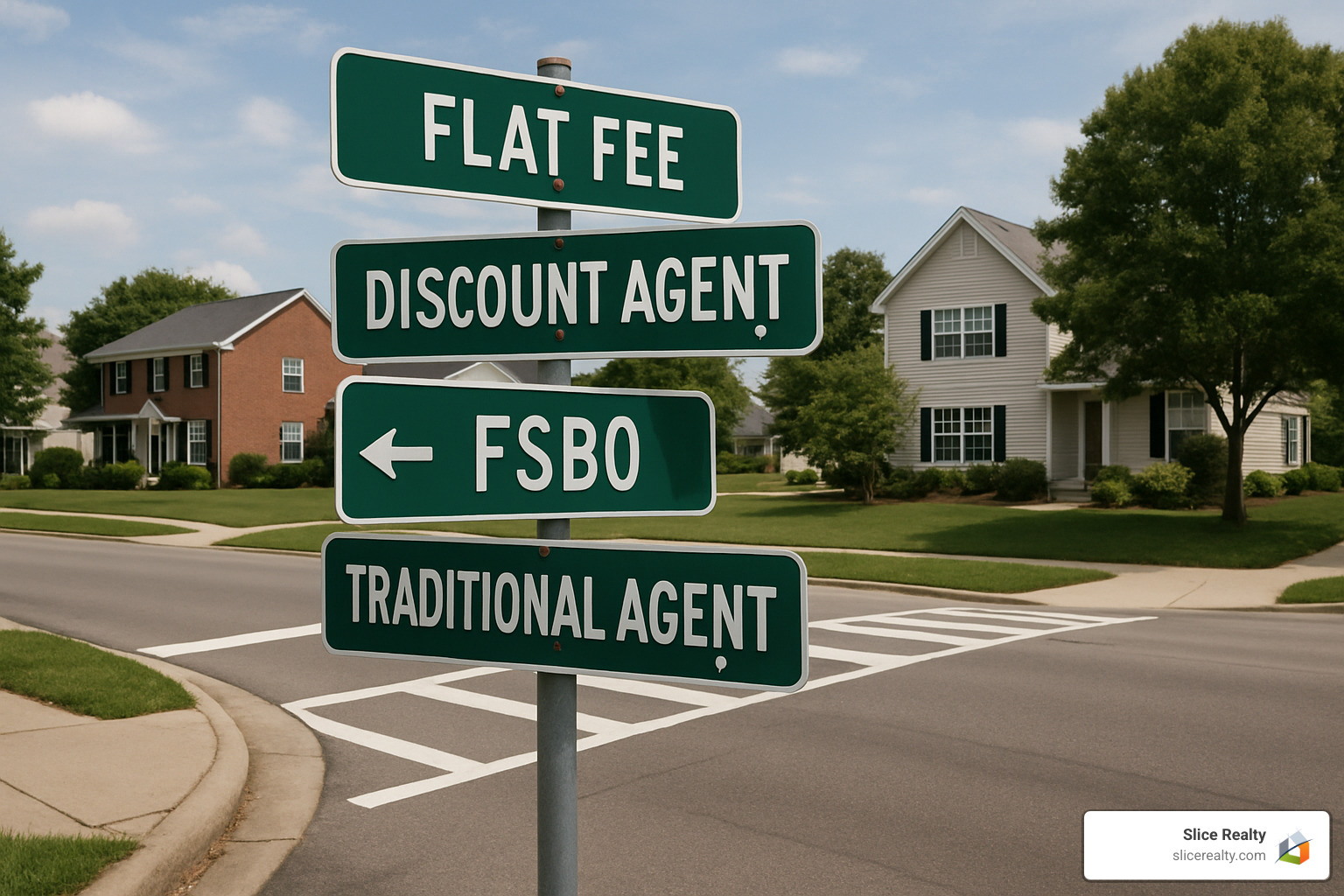
Flat Fee vs. Discount Broker vs. FSBO Quick Snapshot
Here’s how the main alternatives stack up when you’re looking beyond traditional full-service agents:
Service levels vary dramatically. Discount brokers provide full professional service at reduced rates. Flat fee seller agents offer variable service depending on your package. FSBO means you’re handling everything yourself – from pricing to closing coordination.
Cost structures differ too. Flat fees give you predictable costs regardless of sale price. Discount brokers charge reduced percentages that still scale with your home’s value. FSBO costs almost nothing upfront but may cost you more in the long run if you underprice or encounter legal issues.
Time investment is crucial to consider. Discount brokers require minimal time from you – they handle the heavy lifting. Flat fee services typically require moderate involvement, especially for showings and coordination. FSBO demands significant time commitment that many sellers underestimate.
Success rates and net proceeds tell the real story. Agent-assisted sales typically achieve higher prices and faster sales than FSBO attempts. The professional marketing, negotiation skills, and legal protection often justify the cost difference.
The key is matching your choice to your experience level, available time, and risk tolerance. First-time sellers usually benefit from professional guidance, while experienced investors might prefer maximum cost savings.
Frequently Asked Questions About Flat Fee Seller Agents
Are flat fee seller agents available nationwide?
Flat fee seller agents operate in all 50 states, but here’s what most sellers don’t realize: not all flat fee services are created equal. You’ll find national platforms offering cookie-cutter packages alongside regional brokerages providing personalized local expertise.
National companies cast a wide net but often lack the neighborhood knowledge that makes or breaks a sale. They might not understand why homes near Boulder’s hiking trails command premium prices, or how Fort Collins’ student rental market affects timing strategies.
Regional brokerages like ours focus on specific markets where we’ve built deep expertise over years. Since 2009, we’ve served the Colorado Front Range including Boulder, Superior, Denver, Colorado Springs, Fort Collins, Erie, and Aurora. This local knowledge helps us price homes accurately and steer Colorado-specific regulations that can trip up out-of-state agents.
The trade-off is geographic reach. While national platforms can help you sell homes anywhere, regional experts provide the market insights that often determine whether your home sells quickly at the right price.
Do flat fee agents affect final sale price and days on market?
This question gets to the heart of every seller’s concern: Am I sacrificing money to save on commissions?
The research tells an interesting story. Homes listed on MLS – regardless of whether they’re listed by traditional or flat fee seller agents – sell for approximately 38% more than comparable FSBO properties. That’s a huge advantage that justifies the flat fee cost.
But here’s where it gets nuanced. Some flat fee agents focus on volume over value, prioritizing quick sales to maximize their profit per hour invested. Others provide the same level of marketing support and negotiation expertise as traditional agents.
The key difference isn’t the fee structure – it’s the service level. Well-executed flat fee listings typically sell within normal market timeframes at competitive prices. The challenge is finding agents who don’t cut corners on the services that actually impact your sale price.
From our experience, homes succeed when agents provide adequate marketing support, professional photography, and skilled negotiation. The commission structure matters less than the agent’s commitment to getting you the best possible outcome.
What services are usually included in a flat fee listing?
This varies so dramatically that it’s almost misleading to give a general answer. Some flat fee seller agents charge $500 for bare-bones MLS listing while others provide comprehensive support for $5,000.
Basic packages typically include MLS listing with basic photos, syndication to major real estate websites like Zillow and Realtor.com, a basic yard sign, and lockbox for showings. Think of this as the absolute minimum to get your home visible to buyers.
Full-service packages often add professional photography and virtual tours, comparative market analysis for accurate pricing, marketing across multiple channels, showing coordination and feedback collection, offer negotiation support, and closing coordination. This level approaches traditional agent service while maintaining flat fee savings.
The middle ground – where many sellers find the sweet spot – includes professional photos, MLS listing, basic marketing, and limited support for negotiations. You save money while getting the essential services that impact your sale.
Here’s my advice: Always review service agreements carefully before signing. Ask specifically about photo quality and quantity, marketing reach, response times for questions, and what happens if negotiations get complex. The cheapest option isn’t always the best value if it leaves you struggling through difficult situations alone.
Understanding exactly what’s included in your flat fee helps you prepare for the responsibilities you’ll handle yourself – and ensures you’re comparing apples to apples when evaluating different brokerages.
Conclusion
Choosing a flat fee seller agent isn’t just about saving money – though those savings of $10,000 to $50,000+ compared to traditional commissions are certainly attractive. It’s about finding the right fit for your specific situation and comfort level.
The truth is, not every seller benefits from the flat fee model. If you’re selling your first home, dealing with a complex property situation, or simply prefer having someone handle every detail, a traditional agent might be worth the extra cost. But if you’re an experienced seller with a well-maintained home in a decent market, the flat fee approach can put tens of thousands of dollars back in your pocket.
The key is knowing what you’re getting. Some flat fee services will leave you scrambling to handle showings, negotiations, and paperwork on your own. Others provide comprehensive support that rivals traditional full-service agents. The difference often comes down to the brokerage’s philosophy and local expertise.
At Slice Realty, we’ve been helping Colorado sellers steer this landscape since 2009. Our lawyer-led approach means you get both the cost savings and the legal protection that comes with professional expertise. We’ve seen too many sellers get burned by fly-by-night operations that promise the world but deliver minimal service when things get complicated.
Your home sale is too important to leave to chance. Whether you choose our flat fee model, work with a discount agent, or go the traditional route, make sure you understand exactly what services you’re getting and what you’ll need to handle yourself. Ask the tough questions upfront, get everything in writing, and don’t be afraid to walk away if something doesn’t feel right.
The Colorado real estate market offers plenty of opportunities for savvy sellers who do their homework. If you’re ready to explore how our flat fee model might work for your situation, we’d love to discuss your options. You can also browse our Front Range homes for sale to get a feel for current market conditions.
The best agent for you isn’t necessarily the cheapest or the most expensive – it’s the one who provides the right combination of service, expertise, and value for your unique needs. Sometimes that means paying a bit more for peace of mind. Other times, it means keeping more of your hard-earned equity by choosing a smart flat fee approach.
